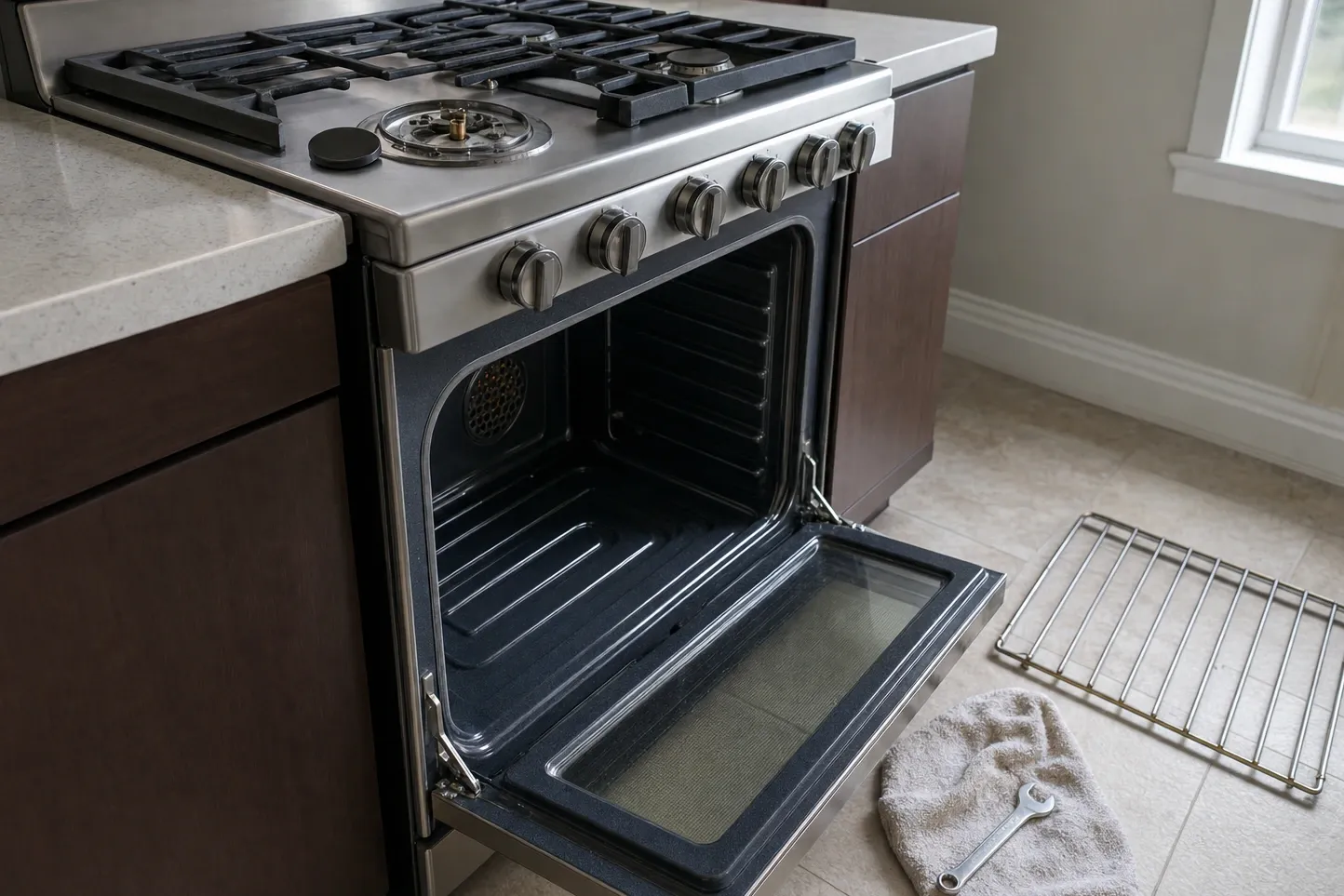
Before You Call · Cooktop Repair
Wolf burner clicks but will not light: what it means
Endless sparking with no flame hardly ever means the cooktop is finished. What the clicking is telling you, the four small parts behind it, the checks you can safely make, and the point where it stops being a ten-minute job.
Written by
Gustavo Peralta
- Trade
- Cooking-appliance technician — doors, hinges and seals
- Doing this for
- 19 years
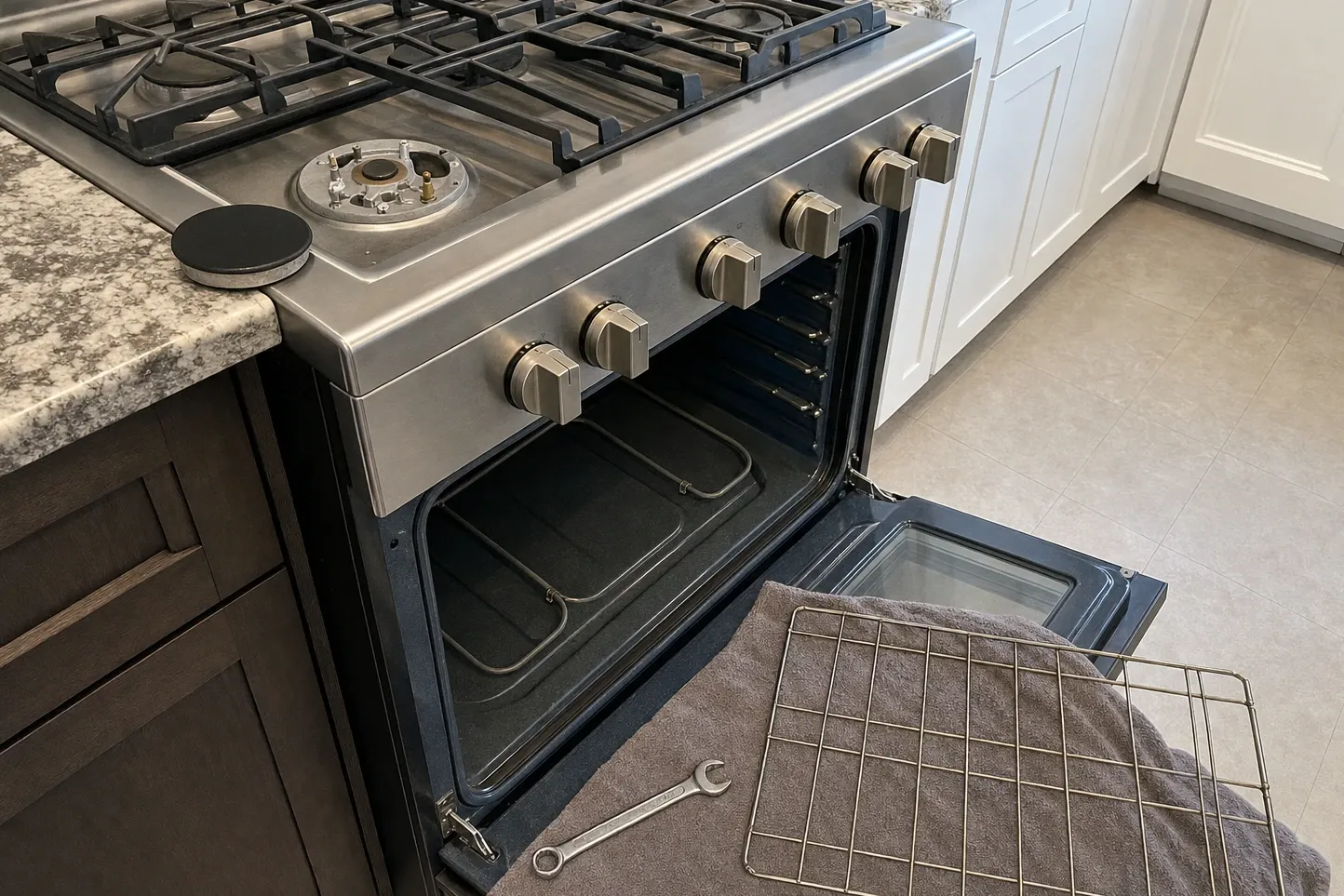
A Wolf burner that clicks and clicks and never catches is the most common call we take on the westside, and it is also the one people most often assume means a new cooktop. It almost never does. The clicking tells you that most of the system is working — the switch closed, the module woke up, the spark is being generated. What has gone wrong is one small thing in the path between that spark and the gas.
What the clicking actually is
Every sealed burner on a Wolf gas cooktop or rangetop has a spark electrode sitting in a small well beside the burner head, wired back to a spark module under the cooktop. Turn a knob to the light position and two things are supposed to happen together: the valve opens and gas flows out through the burner ports, and the module fires the electrode several times a second until a flame sensor tells it to stop.
The clicking you hear is the module doing its job. So a burner that clicks without lighting has ruled out a whole category of faults for you already: the switch, the module’s power and the module itself are all probably fine. The problem is that the spark and the gas are not meeting each other.
The four things that stop a burner lighting
The cap is not seated. This is the one to check first because it costs nothing. Burner caps sit on a locating ring, and after cleaning it is very easy to drop one back a millimetre off centre or slightly tilted. That is enough to move the flame path away from the electrode. On a rangetop with several similar caps it is also easy to swap a small one onto a large burner, which does the same thing.
The ports are blocked. Boil-over caramelises in the ports and sets hard. In the canyon houses above San Vicente and up towards Stone Canyon we also pull a surprising amount of fine dust out of burner ports, because that is what gets drawn through an open window and settles on a cooktop. Blocked ports near the electrode mean no gas where the spark is, even though the rest of the ring lights normally.
The electrode is wet or cracked. Wet is common and self-solving: water sitting in the electrode well after a wipe-down shorts the spark to the burner body. Cracked is a repair. The white ceramic insulator around the tip chips or crazes, the spark takes the short path through the crack instead of jumping the gap, and nothing lights. On the Palisades bluffs we see the metal tip corroded away as well — salt air is unkind to spark hardware and it goes for the electrodes and the leads long before it touches anything else.
The lead has come off or chafed. Spark leads run under the cooktop through a warm, greasy environment and they get moved every time somebody works under there. A lead that has vibrated off its terminal gives you a module that clicks and a burner with no spark at all.
What you can check safely in ten minutes
Turn the cooktop off first and let it cool.
- Lift each cap off, check it against its neighbours for size, and set it back down deliberately until it drops flat onto the ring. Nudge it and see if it rocks.
- Look into the electrode well. If there is any moisture, leave the cap off and give it a day. A hair dryer on cool helps.
- Look at the electrode tip in good light. You want an intact white insulator and a clean metal tip. Chips, cracks, brown scorching along the ceramic or a tip that has gone thin and rough all point to a replacement.
- Look at the ports around the ring nearest the electrode. If they look glazed or filled, they are.
Everything on that list is done with the appliance off and cold. Do not turn a knob to the light position with a cap off to see where the spark goes: that opens the valve and lets gas out at an uncovered burner while the module is firing, which is the same sequence that produces the bang described further down this page. Watching where the spark actually jumps is part of the $89 visit, and it is done with instruments rather than in a darkened kitchen.
What not to do: do not clear ports with a needle or a pin. It is easy to widen or deform a port, and a deformed port gives you a flame that lifts off and blows itself out — a worse problem than the one you started with, and harder to diagnose afterwards because it looks like a regulator fault.
When it is the spark module, not the burner
If several burners have stopped lighting at once, or two burners light whenever you turn one knob, the fault has moved upstream to the switch bank or the module. Two burners lighting together is nearly always grease that has run down the fascia into the ignition switches and bridged two channels. We see that most often in the older Hancock Park kitchens, where the range has been in place a long time and a lot of frying has happened in front of it.
A module that clicks continuously with every knob in the off position is a different matter. That is a stuck switch or a failed module, gas is not flowing but the appliance is not behaving, and it should be shut off at the gas cock rather than left clicking.
When to stop and call
Stop and call if you can smell gas at any point, if a burner lights with a thump you can hear in the next room, if there is any scorch mark around a switch or the fascia, or if the clicking will not stop with everything off. Those involve fuel or wiring and they get worse.
Call, without any urgency, if the cap seats properly, the well is dry, the ports look clear and it still will not light. At that point it is an electrode, a lead or a module — all small parts, all an hour or so of work, and all things worth getting right rather than replacing in sequence to see which one it was.
Follow-ups
Can I keep using the other burners while one clicks?
If the clicking stops when you turn that one knob off, and you cannot smell gas, the others are safe to use. If the module keeps clicking with every knob off, stop using the appliance and book it. If you can smell gas at any point, close the knobs, leave the room and make the call from outside.
Why does it light with a match but not on its own?
Fuel and valve are both doing their job, then, which narrows the fault to the sparking side of the burner — electrode, lead or module. Treat it as one test result and no more. Making a habit of the match is a poor idea, because every attempt lets unburnt gas gather before anything catches.
The clicking started right after I cleaned the cooktop. Coincidence?
Usually not. Water finding its way into the electrode well or under the cap is the single most common cause of a burner that clicked fine yesterday. Give it a full day to dry with the caps off before assuming a part has failed.
Is a cracked electrode dangerous?
It is not dangerous in itself, but a cracked ceramic insulator lets the spark jump somewhere other than the burner, which means gas flows without igniting. That delay is what produces the loud thump when it finally does catch, and that is worth fixing rather than living with.
What settling this costs
Wolf Burner Igniter Replacement Cost
Published bands, installed, with the $89 visit credited against the work once you approve it.